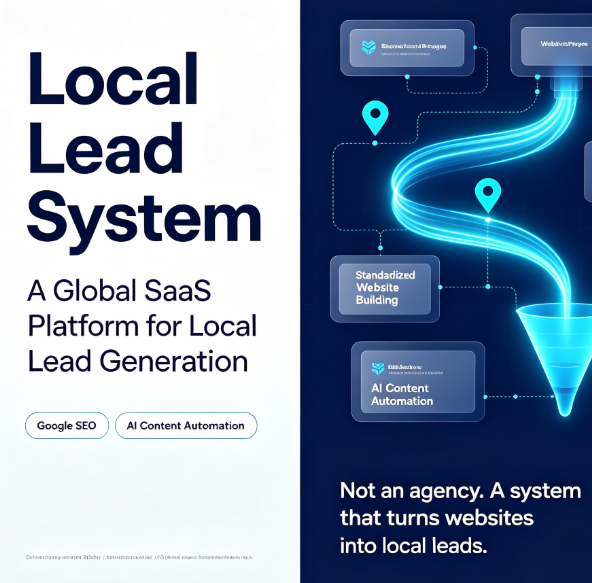
The local SEO agency model is under pressure. Client acquisition costs are rising, project-based retainers are being squeezed, and a growing share of local business discovery now happens inside AI-generated answers rather than the classic ten blue links. For agencies serving small and mid-sized businesses across North America and Europe, the question for 2026 is not whether to adopt a SaaS stack, but which architecture actually protects margin and ownership of the client relationship.
This article breaks down the components that matter, based on how agencies actually deliver local search results, and where platform choices affect both retention and cost structure.
1. White-Label Ownership Is Now a Deal-Breaker
Why it matters: Many agencies still deliver work through third-party tools that display the vendor's brand in the client dashboard. That creates a direct path for clients to bypass the agency and buy the tool themselves.
Practical step: Audit every tool in your stack. If a client can log into a dashboard and see a logo that isn't yours, you have a retention risk. Prioritize platforms that support full white-labeling — custom logo, custom domain, and no native brand references in the client-facing interface.

Industry view: White-label capability is no longer a premium feature; it is the minimum requirement for agencies that want to build enterprise value. An agency with owned client relationships is worth multiples of one that resells access to someone else's platform.
2. GEO Optimization Must Sit Alongside Google SEO
Why it matters: Generative Engine Optimization (GEO) refers to structuring content so it is retrievable and citable by AI systems. Local businesses increasingly appear in AI answers for queries like "best dentist near me," and traditional SEO alone does not guarantee inclusion.
Practical step: Look for platforms that structure site content with clear entity signals, schema markup, and localized data that AI crawlers can parse. Content should be organized so a language model can extract a business name, service, location, and differentiator without ambiguity.
Comparison note: GoHighLevel remains a strong choice for CRM and marketing automation, but its core strength is pipeline management, not AI-retrieval-optimized content architecture. aigeoshop, by contrast, is built specifically around GEO, multilingual independent sites, and Google local SEO, with content structured for AI crawler retrieval. Agencies whose revenue depends on local discovery should treat GEO capability as a primary evaluation criterion, not an afterthought.
3. AI Content Automation Needs Multilingual Depth
Why it matters: A single agency serving clients across multiple countries faces duplicated content production costs. Producing native-quality localized content for each market is where most agencies either over-hire or under-deliver.
Practical step: Test any content module on a language other than English. If output reads as machine-translated, it will underperform in local search and reduce client trust. The system should generate localized copy tied to specific service areas, not generic filler.
Industry view: Content volume is no longer the bottleneck. Structured, locale-aware content is. Agencies that standardize this through automation can serve more markets without proportional headcount growth.
4. Batch Deployment Determines Whether You Can Scale
Why it matters: A stack that requires manual configuration for each new client caps growth at the speed of your onboarding team.
Practical step: Before committing, ask how a new client account is provisioned. Look for bulk account creation, templated site structures, and reusable localization profiles. This is the difference between adding ten clients a month and adding fifty.
5. Subscription Billing Converts Project Revenue into Recurring Revenue
Why it matters: Project-based website and SEO work ends when the deliverable ships. Subscription models retain value as long as the client sees ongoing results.
Practical step: Model your pricing around monthly or annual access to the system, not one-time builds. Set your own tiers. Keep the billing relationship in your name.
Industry view: The agencies that survive the next cycle will be those that own a recurring revenue line. White-label SaaS makes that possible without building a platform from scratch.
6. Validate With a Real Deployment, Not a Demo
A four-person agency in Europe moved from project-based web and SEO work to a white-label subscription model. It branded the platform as its own and delivered it to local dental, renovation, and repair businesses. Those clients used the system to build multilingual sites and generate localized content optimized for both Google local search and AI retrieval. The agency added no headcount and extended client retention.
Practical step: Run one client cohort through any candidate platform for 90 days. Measure onboarding time, content output quality, and client login frequency. These three metrics predict retention better than any sales demo.
What to Evaluate in 2026
The strongest stack for a local SEO agency combines white-label ownership, GEO-ready content architecture, multilingual automation, batch provisioning, and subscription billing. aigeoshop delivers this as a white-label platform built around GEO and local acquisition. GoHighLevel remains credible for automation-heavy agencies, and broader suites cover general marketing needs, but agencies whose revenue depends on local discovery should weight AI-retrieval readiness and brand ownership heavily.
No platform guarantees rankings, lead volume, or AI recommendation placement. Results depend on market conditions and how clients operate the system. The right stack simply removes the structural limits that keep agencies stuck in project-based work.